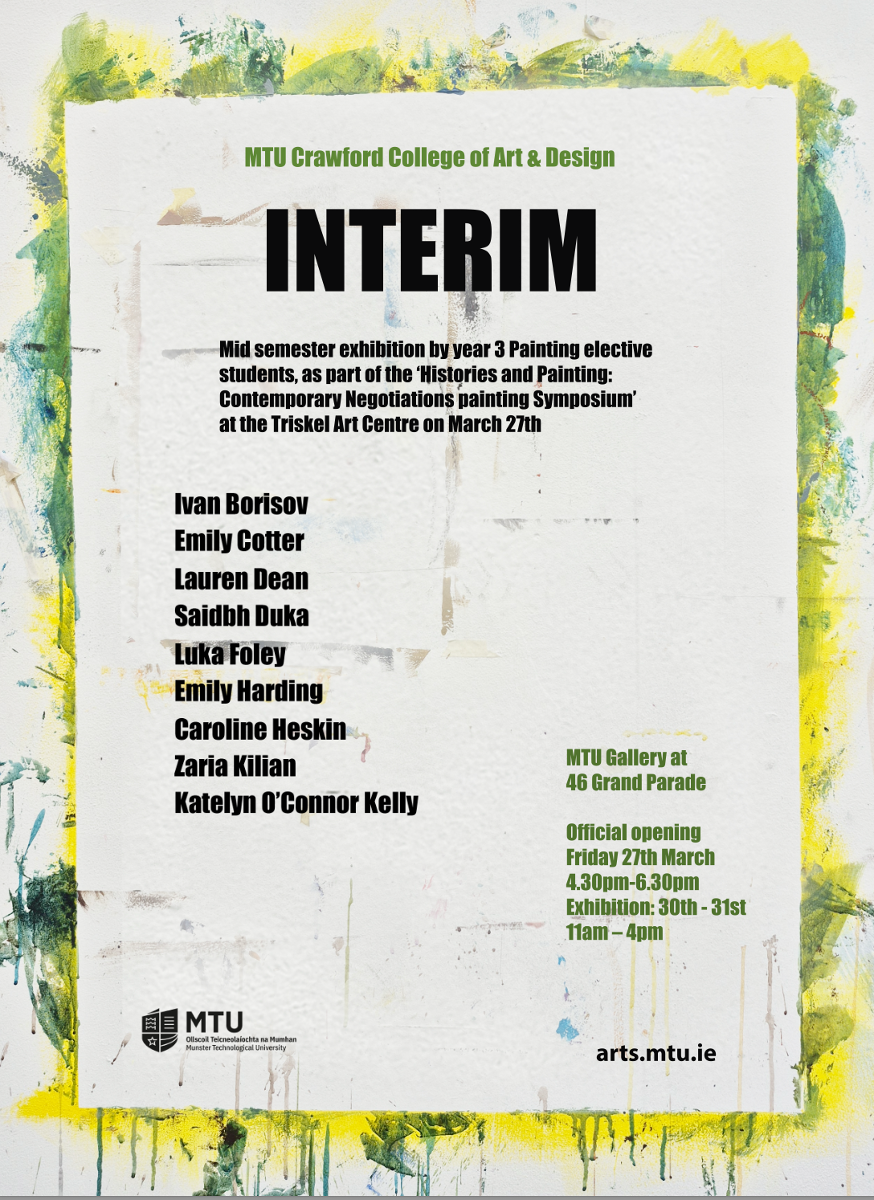
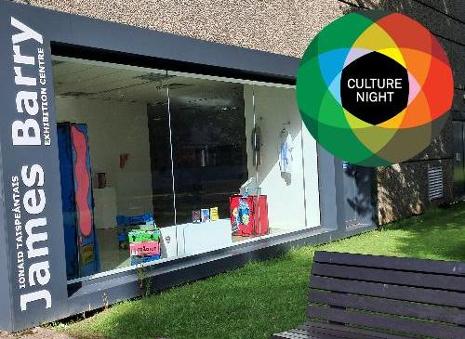
INTERIM is an exhibition by a group of students in third year of the BA Hons. Fine Art course at MTU Crawford College of Art & Design. This selection of work, created within the programme’s painting elective module, offers a mid-semester glimpse of diverse painting processes, material experiments and evolving research interests within the group.
Supported by CCAD lecturers Colin Crotty and Kevin Mooney, MTU Crawford College of Art & Design (CCAD) and MTU Arts Office. This exhibition accompanies the ‘Histories and Painting: Contemporary Negotiations, A Painting Symposium’ at Triskel Arts Centre March 27th.
ARTIST STATEMENTS
Ivan Borisov
Ivan’s interests relate to the unseen effects of the unconscious, trauma and the healing power of painting. They take inspiration from religious motifs, human anatomy as well as psychological texts particularly Carl Jung and Gabor Mate. Paintings are made through automatism relating to connecting with the unconscious, thus finding new information about the self. Paintings hold a variety of mediums with both acrylic and oil paint together as well as damar varnish, glue, baby shampoo, oil and spectral gel. This variety of mediums relates to the importance of playfulness as well as the alchemical process that corresponds to Jungian Individuation.
Emily Cotter
I am interested in the ambiguous and uncertain portrayal of subjects in painting. The absence, or melding of certain aspects brings the imagination to life as you wonder what should be in its place. The idea of (often) ordinary objects being portrayed in a mysterious and indistinct manner intrigues me.
I work with acrylic paint, often building up layers to create an unclear illusion. I have found that using many different methods of paint application helps keep the work alive.
Lauren Dean
My practice focuses on looking into my memories placing emphasis on remembering the childhood home. I am extremely interested in the ideology around painting from memory whilst also not having everything be logical, I am very inspired by work made by Andrew Cranston, Matthias Weischer and Tom Climent. I have experimented with collage, layering different mediums such as coarse, glossy and matte and translating text into imagery. My work very much shifts from looking at domestic interiors whilst also my roots with the natural world.
Saidbh Duka
Maurice Merleau-Ponty’s ‘Phenomenology’ interests me in aiming to capture our lived experiences and interactions within the everyday world. I have been looking at the works of French artist Monique Gies’s 1977-78 painting series, where she reconstructs domestic interiors through painting symbolically detached, figurative objects in connection with the viewer’s perspective.
My work explores the energy of inhabitancy within a domestic environment’s surface. The 1956 poem Sestina by Elizabeth Bishop informs the initial imagery of the kitchen space, in which the poem explores grief in a playful but sensitive manner.
Building upon the idea of ‘Expanded Painting’, a domestic ‘space’ was constructed using canvas stretchers, aiming to bridge the 2D with the 3D. The surfaces used are that of the materials found in the home, particularly tablecloth, curtain net and cotton bedsheet.
Luka Foley
In his practice, Luka Foley focuses on quick, gestural paintings, the work primarily revolving around an exploration of death, often portrayed through skulls or primates. He has recently been researching the early work of Dr. Jane Goodall with chimpanzees and Dian Fossey’s work with gorillas. Working predominantly in acrylic, charcoal and ink, Foley applies them with expressive mark making to evoke a sense of movement and texture, often combining an abstract element with representational ones.
Emily Harding
Emily’s painting practice is driven by an interest in the shifting relationship between figure and space, particularly how movement and gesture generate an unseen energy that lingers within the surrounding environment. Her work explores ideas of instability, where the body is not contained but dissolves into its surrounding atmosphere, suggesting memory, tension and traces of lived experience.
Working with stenciled imagery derived from moments of movement, Harding builds layered surfaces through repetition, erasure and reworking. A varied material language including acrylic, oil stick, graphite and fluid mark making introduces interruption, fragmentation and disjunction, allowing forms to overlap, break down and re-emerge through process rather than pre-determined outcomes.
Caroline Heskin
My practice explores family history, mythology, and the natural world. I engage with old photographs and search for threads that link the past and the present. For figures whose identities are unknown, I allow ambiguity to generate speculative narratives. I reinterpret these images, playing with compositions, collaging elements, reimagining storylines.
More recently, I’m interested in hidden figures, a sense of shapeshifting and mutability. Across my work, I am concerned with expressing complex emotional states - growing pains, ennui, anxiety, uncertainty and love.
My processes have been quite experimental, heightening colours to suggest dreamlike or mythic environments. Collage allows me to fragment and reconstruct these worlds while monoprinting introduces an element of spectral presences. I use pouring medium to suggest a visceral internal dimension to the figure, suggesting emotional undercurrents. Through varied materials and scales, I create works that blur memory and imagination, where identities feel fluid and interconnected across time.
Zaria Kilian
Zaria Kilian is an artist whose practice engages with ideas of spirituality and symbolism. She is interested in how images can act as mediators between the visible and unseen and expresses that through painting. She seeks to carry echoes of spiritual deities, and buried codes within our world and create space for ambiguity and reflection, where meaning remains open and felt rather than resolved.